


A pool treadmill turns a section of a pool into a controlled walking or running surface. Instead of moving across a dry belt, you move against water while buoyancy, pressure, and drag change how each step feels. That makes the equipment different from a swim spa, which uses counter-current flow to support swimming in place.
Browse water-aerobics gear for your pool exercise routine.
A pool treadmill is an aquatic exercise machine with a walking belt or submerged treadmill surface. Water can support part of the body's weight, while its viscosity creates resistance as you walk or run. The effect depends on factors such as water depth, equipment design, and your pace. So buyers should compare the machine with their goals, pool dimensions, and available installation or storage options. Research on aquatic treadmill exercise describes buoyancy, hydrostatic pressure, and viscosity as key influences.
To evaluate one intelligently, start with how the equipment works underwater, then consider what changes when the water reaches different heights around the body.
What Is a Pool Treadmill and How Does It Work?
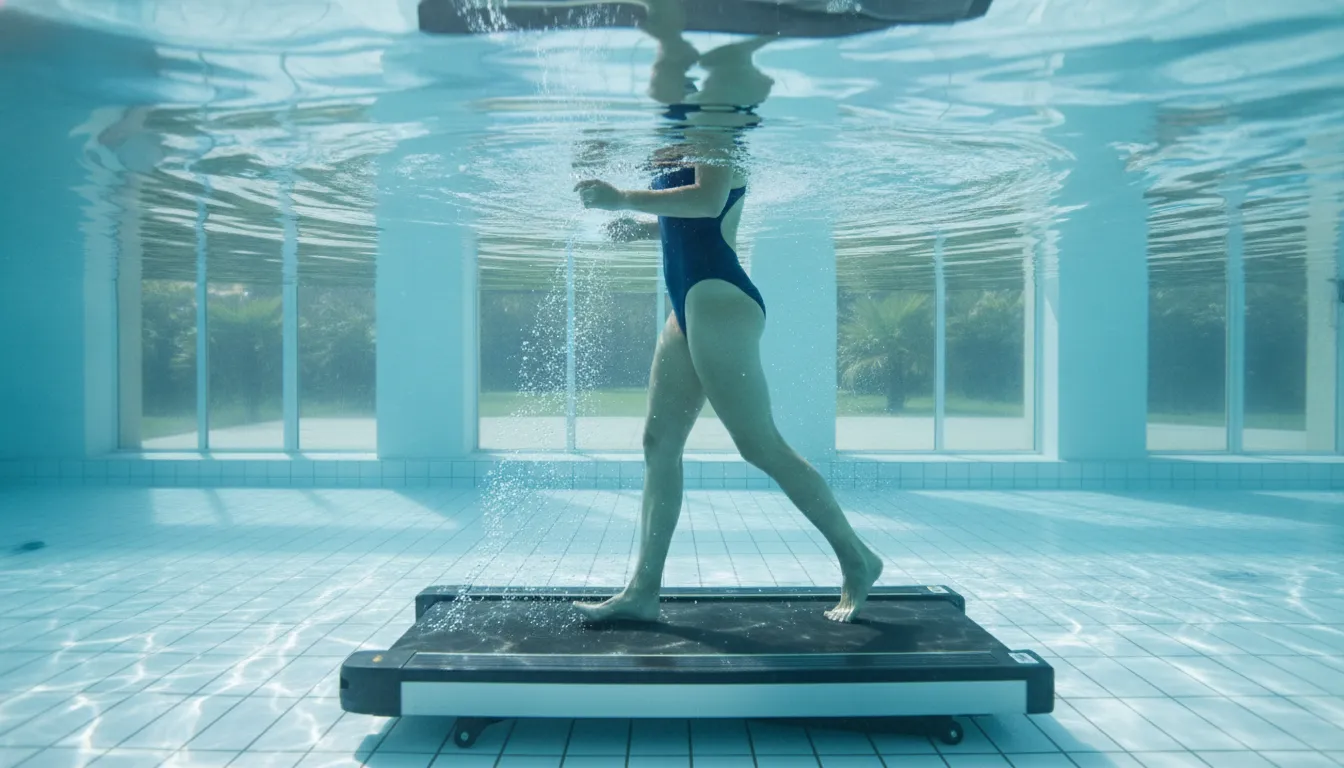
A pool treadmill is an underwater exercise device with a walking surface that lets you walk, jog, or run while surrounded by water. Unlike a swim spa, a pool treadmill provides a belt or platform for forward movement against water resistance. A swim spa uses counter-current flow for swimming in place.
Buoyancy changes how your body is supported
When you step into the water, buoyancy supports part of your body weight. The amount of support depends on immersion depth. A review of aquatic treadmill research reports that water around the pubic-symphysis level relieved about 40% of body weight, while navel-height water relieved about half. At the xiphoid level, the reported reduction exceeded 60%. These figures come from a cited report, not a universal setting for every pool treadmill, so the user's position and the equipment design still matter.
Pressure and viscosity add resistance
Hydrostatic pressure increases as immersion depth increases. Water viscosity also creates friction against the skin, while the surrounding water produces fluid resistance as the body and legs move. Together, these properties can make each step feel different from a land-treadmill step. Moving faster or pushing more water generally demands more effort, but the exact sensation depends on water depth, treadmill design, speed, and technique.
These mechanics are why pool treadmills are best understood as aquatic walking or running equipment, not as swim spas with a belt added. For a research overview of buoyancy, hydrostatic pressure, viscosity, and aquatic treadmill movement, see the academic review of underwater treadmill training.
How Does Water Resistance Change Walking and Running?
A pool treadmill changes movement through several interacting properties of water. Depth affects how much of the body is supported by buoyancy, while hydrostatic pressure increases with immersion. Water viscosity also creates friction against the skin, and the surrounding water produces drag as the legs and arms move. Together, these factors make aquatic walking or running mechanically different from the same activity on a land treadmill. Research on underwater treadmill exercise describes buoyancy, hydrostatic pressure, and viscosity as central features of the environment.
Depth changes support and pressure
As water rises around the body, buoyancy can reduce the amount of body weight carried through the feet. One report cited in the research review estimated roughly 40 percent weight relief at pubic-symphysis depth. About 50 percent at navel depth, and more than 60 percent at xiphoid depth. These figures are reported estimates, not a universal setting for every person or machine. Actual support depends on body position, water level, equipment, and how the exercise is performed.
Deeper immersion also changes hydrostatic pressure because pressure rises as immersion depth increases. That means moving from waist depth to chest or neck depth is not simply a matter of adding more water around the legs. The surrounding pressure and the amount of buoyant support change together, so a pool treadmill session can feel different even when the belt speed stays the same.
Drag changes the way each step feels
Water resists movement in every direction. The faster a limb moves, the more noticeable that resistance can become, and changing direction or body position changes the drag as well. This can make the swing phase of walking feel slower and more deliberate than it does on land. Rather than treating water resistance as a fixed number, evaluate it as a product of depth, pace, body movement, and the design of the treadmill or water-flow system.
A gait study comparing waist, chest, and neck depths found significant differences in measured walking biomechanics. At neck depth, participants showed longer strides and lower cadence than at waist or chest depth. The waist and chest conditions did not differ significantly in the measured variables. The authors identified buoyancy and drag related to water depth as likely contributors. Read the gait study PDF for the full methods and limitations.
Running intensity can also be adjusted through speed and resistance rather than belt speed alone. In a study of 23 college runners, aquatic and land treadmill tests produced similar measured peak cardiorespiratory responses under the study protocols. The aquatic test used xiphoid-depth water and progressively increased treadmill speed and water-jet resistance. Those findings describe a specific research setup, so they should not be treated as a guarantee for every pool treadmill or user. View the PubMed record for the study details.
Who Commonly Uses a Pool Treadmill?
Pool treadmills can serve several kinds of aquatic exercisers, from people building a regular fitness routine to runners looking for a different training environment. The right use depends on the equipment, water depth, personal goals, and any guidance provided by a qualified professional.
Fitness users and aquatic exercise participants
General fitness users may choose an underwater treadmill for walking or jogging against water resistance. Water buoyancy changes how much body weight is supported, while viscosity creates friction around the body. Together, these properties can make the session feel different from walking on land. A 2017 study also examined repeated underwater treadmill sessions in adults who were not part of a patient cohort, using a structured protocol that included comfortable walking. The study reported changes in measured gait outcomes after the intervention, but those findings should not be treated as a guarantee for every user.
People already interested in low-impact pool exercise may also consider a pool treadmill as one equipment-based option. It is distinct from water aerobics classes and other aquatic workouts, so users should compare the movement pattern, available space, and level of supervision before choosing an approach.
Runners and conditioning-focused athletes
Runners may use aquatic treadmill sessions to vary their conditioning work or study how water resistance affects effort. In a study of 23 college runners, aquatic and land treadmill tests produced similar measured peak oxygen consumption and heart-rate responses under the tested protocols. The researchers used xiphoid-depth water and increased treadmill speed and water-jet resistance during the aquatic test. Those results describe a specific study setup, not a universal training prescription, so runners should account for water depth, machine design, and their own training plan.
Supervised rehabilitation settings
Some equipment pages list aquatic therapy and post-surgery rehabilitation among intended use cases. That does not mean a pool treadmill is appropriate for every injury, condition, or recovery stage. Anyone using one for rehabilitation should follow instructions from a qualified clinician, facility, or therapist, including guidance on depth, pace, duration, and safe entry and exit.
Pool Treadmill vs. Swim Spa: What Is the Difference?
A pool treadmill and a swim spa both support exercise in water, but they create movement in different ways. A pool treadmill is an underwater walking, jogging, or running device with a belt beneath the user. A swim spa is a counter-current pool that sends moving water toward the swimmer, allowing the user to swim in place.
The distinction matters when you are comparing equipment for a specific workout. A treadmill gives you a defined walking or running surface and lets you work against the resistance created by moving through water. A swim spa gives you a continuous current to swim against, with the goal of maintaining position while using swimming strokes. Neither category should be treated as a substitute for the other.
| Feature | Pool treadmill | Swim spa |
|---|---|---|
| Primary movement | Walking, jogging, or running on an underwater belt. | Swimming in place against a counter-current. |
| How resistance is created | Water resistance around the body, plus the belt design and user pace. | Adjustable or model-specific water flow directed toward the swimmer. |
| Best fit for | People focused on aquatic walking or running mechanics. | People focused on continuous swim training in a compact pool. |
| Equipment format | An exercise device placed in suitable water. | A dedicated counter-current pool system. |
When the priority is swimming in place rather than walking or running, compare dedicated counter-current systems separately. Swim2000's swim-spa category is distinct from traditional pools and hot tubs, and a pool treadmill should not be treated as a substitute for either category. For either option, confirm the equipment's intended use, water-depth requirements, installation needs, and safety guidance before making a decision.
What Should You Evaluate Before Buying?
Start with the treadmill's operating design. A manual model relies on your movement through the water, while a powered model may offer motor-driven belt movement, adjustable speed, or additional water-flow controls. FitMax describes its aqua treadmill as manual, with resistance that adjusts naturally to the user's pace. Treat manual construction, powered movement, and any flow controls as model-specific features, not standards across every pool treadmill.
Next, measure the pool and the person who will use the equipment. Check the manufacturer's required water depth, the water level at the user's standing position, the maximum user capacity, and the available walking surface. FitMax lists a recommended pool depth of 3 feet 7 inches to 4 feet 8 inches. Its instructions say the water should reach between the user's waist and chest while standing on the treadmill. FitMax also lists a maximum capacity of 300 pounds. Confirm current specifications directly before buying because another model may require different dimensions.
Will it suit the pool surface and your storage routine?
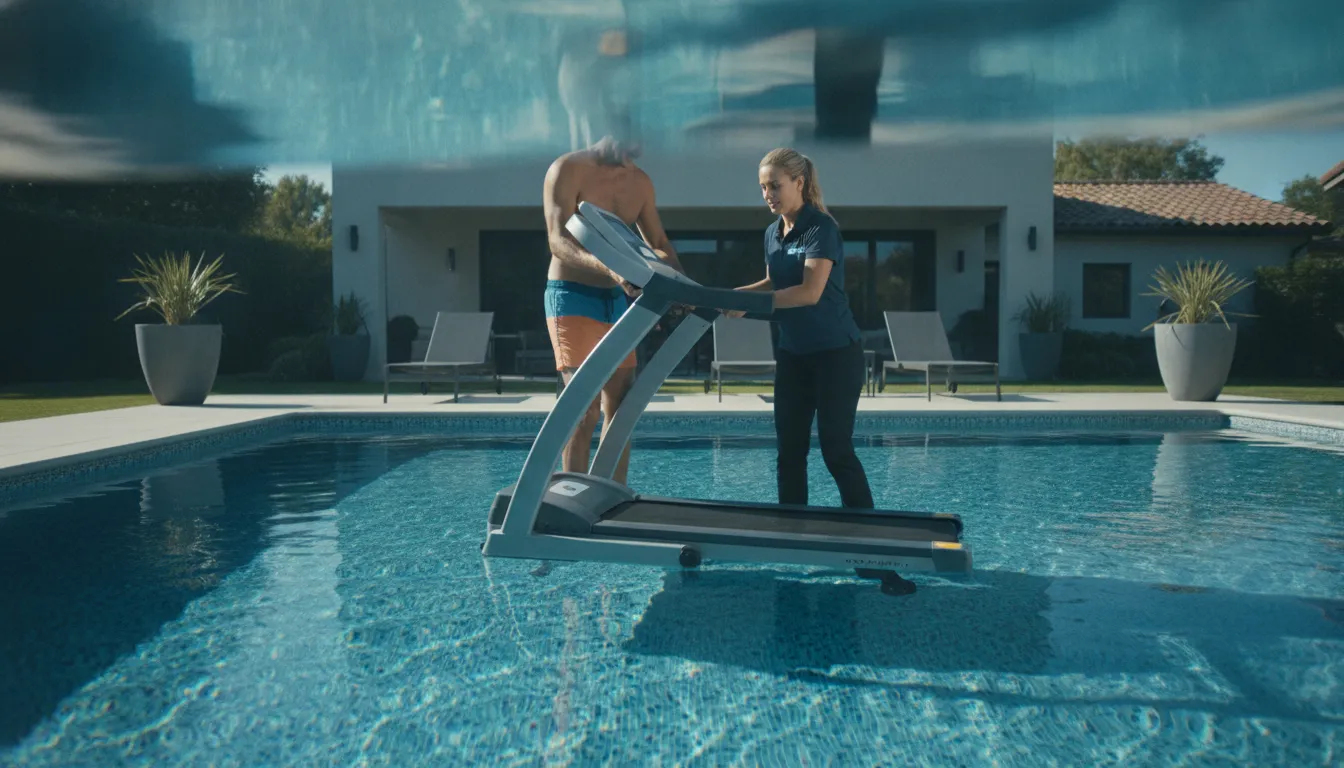
Pool-bottom compatibility deserves a close look. FitMax describes rubber pads and smooth glides intended for vinyl liners, fiberglass, and concrete, but that is a claim about that model's design. Ask whether the equipment is approved for your pool surface, how it stays stable while submerged, and whether the manufacturer requires protective accessories.
Portability matters if the treadmill must be removed after each session. Consider its weight, handles, casters, lifting path, and a dry storage location. FitMax lists an 83-pound unit with front casters. Its care guidance recommends removing the treadmill after use, rinsing it with fresh water, and towel drying it. Also verify compatibility with your water chemistry. FitMax states that its model is designed for normal pool water in the pH range of 7.0 to 7.6 and saltwater. Finally, review every safety instruction, including whether the unit must remain in water during use, before making a purchase.
For related aquatic exercise accessories, browse pool exercise and water-aerobics gear, then compare the treadmill's controls, capacity, dimensions, maintenance needs, and storage demands against your actual pool setup.
Can You Put a Treadmill in an Existing Pool?
Often, yes, but an existing pool is not automatically compatible with every pool treadmill. The answer depends on the equipment's dimensions, the pool's usable depth and floor, how it enters the water, and whether the manufacturer approves that installation. Treat the product manual as the controlling document rather than assuming that a treadmill designed for one pool will work safely in another.
What to check before placing one in the pool
Start with fit. Measure the area where the unit would sit, including clearance for the user to step on and off. Then confirm the standing water depth. One portable model lists a recommended depth of 3 feet 7 inches to 4 feet 8 inches. It calls for water between the user's waist and chest while standing on the treadmill. Those figures apply to that model, not to pool treadmills generally.
Check the pool surface and the equipment's contact points as well. A unit with protective pads may be intended for surfaces such as vinyl, fiberglass, or concrete. You still need confirmation that its weight and movement will not damage your pool finish. Also review access: stairs, deck width, gates, and lifting requirements can matter as much as the pool dimensions.
Portable and integrated systems are different
A portable, drop-in design may be removed after use, rinsed with fresh water, and dried before storage. Some models are manual and do not need electricity, while powered systems require different electrical and installation checks. An integrated treadmill may be built into a dedicated pool or aquatic exercise system, so it should not be treated as a simple drop-in upgrade.
Never operate a model outside the water if its instructions prohibit it. Before use, verify fit, water level, surface compatibility, access, power requirements, and storage with the manufacturer or a qualified installer. Follow pool safety practices, and seek qualified clinical guidance if the equipment is being considered for rehabilitation.
How Should You Compare Pool Exercise Options?
Start by identifying the movement you want to perform, then match the equipment to that activity. A pool treadmill provides a belt or walking surface for moving against water resistance. Aqua jogging uses a running motion in open water, often without a belt, while water aerobics combines repeated movements with equipment such as floats or weights.
- Choose the movement. If you want a consistent walking or jogging path, compare pool treadmill designs. If you prefer intervals, group instruction, or varied standing exercises, review pool exercise and water-aerobics gear.
- Check the water environment. Compare the pool's depth, available floor area, entry method, and surrounding clearance with the equipment's documented requirements. Do not assume that one model's dimensions or setup apply to every pool treadmill.
- Separate structured exercise from free movement. Aqua jogging can provide a simple way to practice water-based running without treadmill equipment. For a different approach, see this guide to water aerobics equipment and benefits.
- Consider resistance variety. A treadmill focuses on stepping or running. Water dumbbells add upper-body resistance and can support other routines, as shown in these water resistance exercise ideas.
- Define the product category. A swim spa is a counter-current pool designed for swimming in place, not simply a treadmill placed in a pool. Compare that format separately when continuous swimming is your priority.
Use the manufacturer's instructions to verify compatibility, installation, operation, and maintenance before choosing equipment. That checklist keeps a pool treadmill decision focused on fit and intended use rather than treating every aquatic exercise option as interchangeable.
For continuous swimming in place, compare dedicated counter-current systems separately and confirm the current product category and installation requirements before shopping.
Frequently Asked Questions
Can you put a treadmill in a pool?
Some models are designed for use in an existing pool, but fit is model-specific. Check the required water depth, the standing position, pool-bottom compatibility, access path, and whether the unit must be removed after each session. Never use a water treadmill out of the water, and follow the manufacturer's installation and safety instructions.
How much does a pool treadmill cost?
Pricing varies by design, materials, features, and whether the unit is manual or powered. Compare the complete purchase and ownership requirements, including delivery, installation, storage, maintenance, and any electrical or water-flow equipment. Confirm current pricing and specifications directly with the manufacturer or installer rather than relying on a general price range.
Do underwater treadmills work?
They provide a moving belt or walking surface while water changes the exercise conditions through buoyancy, pressure, viscosity, and drag. Research has found that water depth affects gait mechanics, so the experience is not identical to walking or running on land. Results depend on the equipment, water depth, pace, and the person using it. Read the aquatic treadmill research review for background.
Is there a home underwater treadmill available?
Home-use options exist, but availability and suitability depend on the model and your pool. Before buying, verify dimensions, user capacity, recommended water depth, power requirements, pool-surface protection, portability, and care instructions. A pool treadmill is also different from a swim spa, which is a counter-current pool designed for swimming in place.
Ready to Explore Pool Exercise Options?
Choosing aquatic exercise equipment starts with matching the setup to how you plan to move, train, or work out in the water. Swim2000 can help you continue exploring related gear for water-based exercise, including equipment suited to water aerobics and pool workouts.


