


Swim starting blocks are more than raised platforms: their surface, handholds, foot support, pool depth, and facility rules all affect how swimmers can practice starts safely. Coaches can use this guide to inspect the setup, teach a repeatable starting position, and progress from deck-based drills to dives only when conditions and skill are appropriate.
What should swimmers and coaches know about starting blocks?
A starting block is a fixed or movable platform at the pool edge that lets a swimmer begin a race or practice start from an elevated position. Competition blocks may include a sloped or adjustable rear footrest, textured standing surface, and handholds. Equipment differs by pool; do not assume every block adjusts in the same way or is approved for every use.
The block is only one part of the start system. The pool edge, water depth, lane clearance, starting signal, and swimmer’s readiness matter just as much. A swimmer should never dive from a block simply because one is present. Coaches and facility staff need to confirm that the lane and water are suitable and that starts are permitted at that time.
Key takeaway: Treat the block as part of a complete, facility-approved setup. Inspect it and the water before practicing, then choose a progression that matches the swimmer’s skill and comfort.
Which block features should you check?
Before a session, take a moment to look at the platform and its surroundings. The purpose is not to certify the equipment; staff should handle repairs and facility approval. A quick visual check can help spot a problem that should be reported before anyone climbs up.
- Standing surface: Look for a stable, clean surface with traction. Water, residue, or a loose covering can change footing. Do not use a platform that moves, rocks, or appears damaged.
- Rear footrest: If the block has a wedge, check that it is secured and that its position is understood. Some designs adjust; others do not. Make changes only as the facility allows, and do not force a mechanism.
- Handholds and edges: Check for visible damage, sharp edges, loose parts, or anything that could catch a hand or swimsuit. Use only the intended grip points.
- Pool edge and deck: Keep the approach and landing area clear of bags, kickboards, and other gear. Wet-deck conditions are normal, but clutter and loose items add avoidable hazards.
- Surrounding lane: Make sure there is space to enter the water and that no swimmer is beneath or directly in front of the block.
For a practice session, place gear away from the start area. A swim gear backpack can keep personal items together, while a kickboard belongs in a designated storage spot rather than on the block or its approach.
If a surface feels slick, a part is loose, or a block is damaged, stop and tell the coach or facility staff. Do not add a towel, tape, or homemade grip to the equipment unless staff approves it. Any modification can shift, bunch, or interfere with the block’s intended use.
Key takeaway: A start-area inspection should cover the platform, rear footrest, approach, and lane—not just the spot where a swimmer stands. Report defects and leave repairs or modifications to facility staff.
How do foot placement and starting position work?
There is no single stance that fits every swimmer, block design, or race start. Coaches can teach a consistent starting position while making sensible adjustments for balance, mobility, confidence, and the facility’s rules. The goal is a controlled setup—not a promise of a faster time.
Set a balanced stance
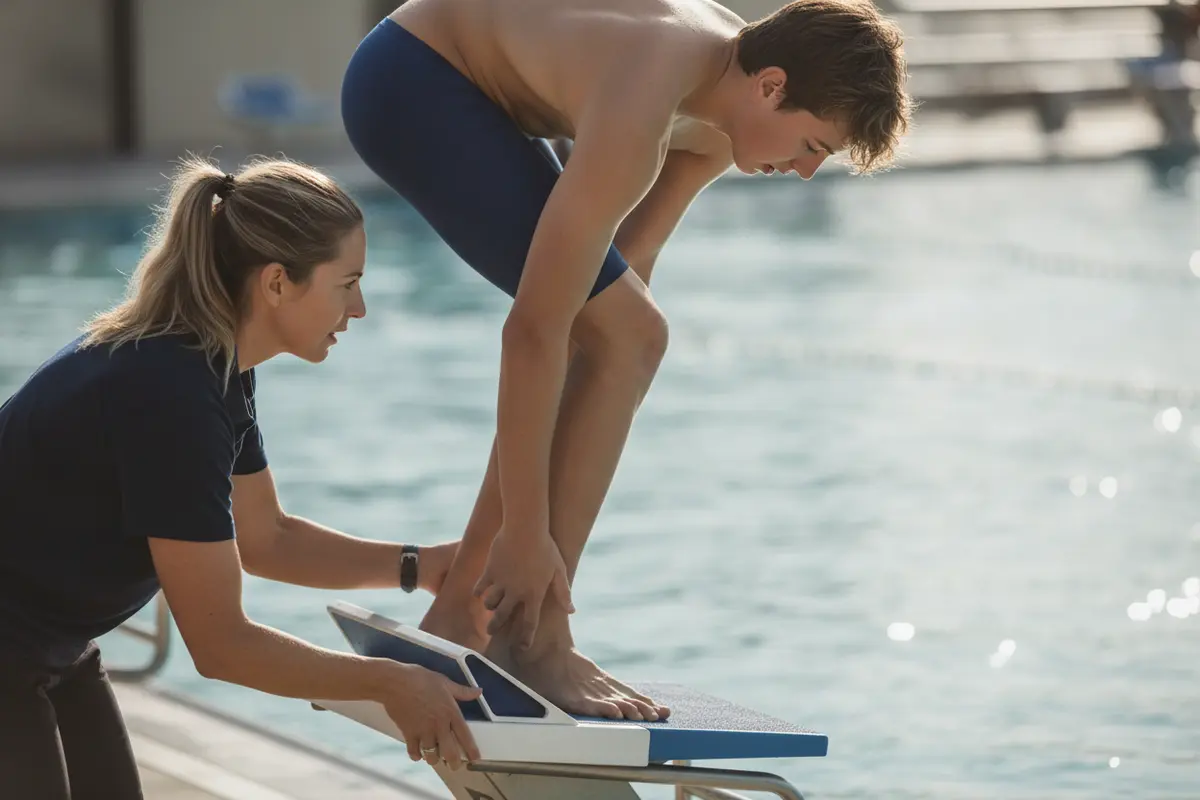
On a block designed for starts, a swimmer typically places the front foot near the front edge and the other foot on the platform or rear wedge, if one is fitted and allowed. The exact distance and angle depend on the swimmer and equipment. Feet should feel stable rather than cramped, and the swimmer should be able to hold the position without slipping or straining.
Before the signal, ask the swimmer to notice whether their weight feels controlled over the feet. A stance that feels unstable should be reset before starting. Avoid asking a swimmer to reach farther, crouch lower, or shift weight aggressively just to imitate someone else’s position.
Use the hands and head deliberately
Where the block design and rules permit, swimmers may hold the front edge or designated handgrips. Hands should be placed securely and symmetrically enough for the swimmer to feel balanced. The shoulders, neck, and jaw should remain comfortable. Avoid gripping a damaged edge or putting fingers underneath a part that could move.
For instruction, separate the sequence into manageable cues: step up only when invited, establish the feet, find a steady hand position, listen for the signal, and leave the block only on the coach’s instruction or authorized start cue. A coach can use the same short cues each repetition, then offer one correction at a time.
Some swimmers use goggles that stay in place during starts; others may need time to adjust fit. Check the seal and strap before practice, rather than making a last-second adjustment on top of the block. For example, swimmers can compare fit with equipment such as TYR Blackhawk racing goggles or pack a goggle case to protect eyewear between sessions. Product fit varies, so swimmers should use gear that feels secure and appropriate to them.
What facility rules and water conditions matter?
Starting rules are set by the pool operator and, for meets, the governing organization and competition. Coaches should ask where starts are allowed, which blocks may be used, whether a lifeguard or staff member must be present, and what signal or lane rotation applies. General practice guidance does not replace posted rules or direct supervision.
Water depth is a critical facility consideration. World Aquatics’ 2024 competition regulations specify a minimum depth of 1.35 metres, extending from 1.0 metre to at least 6.0 metres from the end wall, for pools with starting blocks. That is a competition regulation, not a universal permission for every pool or swimmer; facilities may set additional restrictions. Check the current rules that govern the pool and event rather than relying on memory or a measurement taken by a swimmer. Read the cited competition regulations.
Before a dive, staff or coaches should also consider whether the lane is clear, whether other swimmers understand the rotation, and whether the water entry is free from obstructions. Do not start if a swimmer is still completing a length or resting in the entry zone. Keep swimmers behind the block until the prior swimmer has cleared the area as directed by the facility.
Accessibility and individual accommodations are part of safe planning. The Potomac Valley Swimming coaches’ guide recommends practical accommodations such as mats at the pool edge to facilitate safe wheelchair transfers and towels on starting blocks to help prevent abrasions. The guide’s examples are not a substitute for an individual plan or pool approval; coordinate with the swimmer and facility staff so that any accommodation is safe, permitted, and suited to the person. See the disability guide for coaches.
Facilities may restrict block use for younger, novice, or inexperienced swimmers, and they may prohibit starts during open or shared-lane swimming. Ask staff before beginning. A block being installed does not automatically mean it is open for unsupervised use.
Before a new season or meet warm-up, coaches can ask a few practical questions: Are blocks open for practice today? Which lanes are designated for starts? What is the required waiting position? Who signals each repetition? Are any lanes shared with lap swimmers? Is a staff member required to approve the session? Getting these answers in advance prevents swimmers from copying a start routine from another pool that may have different equipment or restrictions.
For meets, distinguish practice habits from the current event rules. The coach should review the instructions for that venue and competition, including any start procedure that differs from daily training. Swimmers should not assume that a technique or block adjustment allowed at one facility will be allowed elsewhere.
Key takeaway: Confirm depth, supervision, lane use, and facility permission before a block session. Competition regulations and local pool rules may differ, so check the rules that apply to the actual venue.
How can coaches build a safe practice progression?
Progress from understanding the sequence to practicing a start, rather than having swimmers repeatedly dive before they are ready. Keep the group small enough for supervision and make sure everyone knows when it is their turn. For a new swimmer, a coach may decide that block dives are not appropriate yet.
- Explain the rules on deck. Identify the starting lane, who gives the signal, where swimmers wait, and how the next swimmer knows the water is clear. Review the facility’s direction before moving onto the platform.
- Rehearse the sequence without diving. Have swimmers practice approaching, stepping onto the block when invited, placing their feet, finding balance, and stepping down safely. Keep the water entry out of this first drill.
- Add a stable set position. Ask swimmers to hold the position briefly, then step down. If balance or comfort is uncertain, return to a simpler stance or move to a non-block drill.
- Practice a controlled entry only when approved. The coach should confirm appropriate depth, clear water, supervision, and the swimmer’s readiness. Follow the pool’s rules for the direction and type of start.
- Give one specific observation. Focus on one cue—such as stable feet or waiting for the lane to clear—before adding another. Stop if the swimmer reports discomfort or the setup changes.
- Review between repetitions. Allow swimmers time to reset, listen, and recover. Do not turn the block area into a crowded queue.
Dryland rehearsal can help swimmers remember a sequence without taking a dive. Keep the movement within the space available and avoid jumping from benches, starting platforms, or other improvised heights. For in-water practice unrelated to starts, a pair of training fins or swim kickboard may support separate drills when the coach chooses them; neither replaces supervision or block instruction.
For swimmers with limited mobility, a disability, injury, or discomfort on the block, discuss alternatives with the swimmer and relevant staff rather than insisting on a standard start. That may mean beginning in the water, using another approved starting position, or observing the sequence before participating. Safe participation is more important than matching a teammate’s start.
Watch for signs that the progression is moving too quickly. A swimmer who hesitates, repeatedly loses balance, misunderstands the signal, or cannot comfortably reach the intended position may need a simpler step. Pause, ask what feels difficult, and offer a choice to step down or use an approved alternative. Avoid framing a pause as failure; it gives the coach useful information about what to practice next.
Keep repetitions deliberate rather than treating a start set as a race. After each attempt, give the swimmer time to return to the waiting area and listen to feedback. If several swimmers are sharing a block, establish a clear rotation before the first repetition and keep only the next swimmer close to the start zone. The remaining group should wait where they can hear directions without crowding the deck edge.
Feedback works best when it is observable and limited. Instead of saying “be more explosive,” a coach can ask whether the swimmer felt balanced at the set position or whether the lane was clear before leaving the block. This keeps instruction tied to controllable actions and avoids promising that a particular stance will produce a specific race result.
Key takeaway: A good progression is responsive. If confidence, balance, comprehension, or comfort is missing, step back to a simpler rehearsal and only advance when the swimmer and coach are ready.
How do block starts compare with other practice starts?
The best starting method for a session depends on the rules, skill level, pool setup, and training goal. A block start is not necessary for every swimmer or every drill. Use the table as a discussion guide with coaches and facility staff, not as independent clearance to dive.
| Practice option | What it emphasizes | When it may fit | Key check |
|---|---|---|---|
| Deck-based sequence rehearsal | Order of cues, balance, and turn-taking without entering the water | New swimmers or an early teaching stage | Keep the deck area clear; do not rehearse from an improvised height |
| Approved block practice | Familiarity with the actual block and facility start procedure | Swimmers who are ready and supervised under pool rules | Confirm block condition, depth, clear water, and staff approval |
| In-water start or push-off | Entry into a swim from the water or wall, without mounting a block | When block use is restricted or a swimmer needs an alternative | Use only an approach allowed by the coach and facility |
| Non-start swim drill | Separate technique or conditioning work away from the block | Most practice sessions that are not specifically start practice | Use appropriate gear and keep the starting area free of equipment |
A coach may combine options in one session. For instance, a group can rehearse the start order on deck, let experienced swimmers complete a limited number of approved starts, then move everyone away from the blocks for the main practice. A manual lap counter can help track repetitions or lengths during a separate training set, while the coach keeps attention on the start area.
What should teams bring and communicate?
Good planning reduces distractions at the block. Before practice, communicate the facility’s start rules, supervision expectations, and any individual accommodation. Tell swimmers where to wait and where to put equipment. A written deck plan can help visiting swimmers or substitute coaches understand the rotation.
- Bring swimwear and gear suitable for the session, and check fit before reaching the starting area.
- Keep bags, caps, towels, and training aids off the block, lane edge, and entry path until they are needed.
- Identify who is responsible for giving the start signal and stopping practice if the lane becomes unsafe.
- Give swimmers a clear way to ask for a reset or alternative without pressure.
- For team equipment, assign storage and return routines so loose gear does not accumulate around the blocks.
For routine pool training, swimmers may also need a secure swim cap and practice-specific gear such as a kickboard. Keep the setup simple for start sessions: the fewer items placed near the block, the easier it is to maintain a clear approach and entry zone.
What should each swimmer check before stepping up?
A short personal check helps swimmers arrive at the block ready to follow instruction. It does not replace a coach’s or facility’s safety check, but it can prevent avoidable distractions once a swimmer is in the start position.
- Understand the cue. Know whether the coach is asking the group to line up, take a position, or start. If the signal is unclear, ask before getting onto the platform.
- Check comfort and equipment. Adjust goggles, cap, and swimwear on deck. Do not climb onto the block while trying to fix a slipping strap or retrieve an item.
- Know where to wait. Stand behind the assigned line or in the location the coach specifies. Wait until invited, even if the block appears free.
- Look at the entry zone. Make sure the preceding swimmer has cleared the area and follow the coach’s instructions about when the next swimmer may go.
- Speak up. Tell the coach if the block feels unstable, the stance causes discomfort, or a start does not feel manageable. A step-down or reset is part of practice, not a disruption.
Parents of younger swimmers can reinforce these habits by encouraging questions and patience, rather than urging a child to copy an older teammate. Coaches can demonstrate the waiting routine before the group starts, then ask swimmers to repeat it back. That makes the order visible and helps children learning to swim understand that safe starts involve both the swimmer on the block and the people waiting nearby.
After practice, make sure shared training aids are returned to the team’s designated storage area and the block zone is clear for the next group. Report any equipment issue to facility staff even if it did not cause a problem during the session. A new crack, loose part, or change in the pool schedule may need attention before the next practice.
Key takeaway: Swimmers contribute to a safe routine by listening, waiting, checking fit before stepping up, and communicating discomfort. Coaches set the procedure; swimmers should not guess when a start is allowed.
Prepare for a safer, more consistent start session
Reliable start practice begins with the conditions around the swimmer: an approved block, a clear lane, suitable depth, active supervision, and rules everyone understands. Coaches can then teach a balanced stance and build repetition gradually. If a swimmer is uncomfortable, the surface or block looks questionable, or the pool’s instructions are unclear, pause and resolve that issue before resuming.
Frequently asked questions
Can beginners dive from swim starting blocks?
Only when the facility permits it and a qualified coach or responsible staff member considers the swimmer ready. Beginners can first learn the sequence on deck or use an approved alternative start. A block’s presence is not permission to dive.
How should a swimmer place their feet on a starting block?
Use a stable stance suited to the block design and the swimmer. On a block with a rear wedge, the swimmer may place one foot on the wedge if it is secured and permitted. Coaches should prioritize balance and comfort instead of forcing a single stance on every swimmer.
What depth is required for a pool with starting blocks?
Requirements depend on the facility and applicable competition rules. World Aquatics’ 2024 competition regulations specify 1.35 metres of minimum depth extending from 1.0 metre to at least 6.0 metres from the end wall for pools with starting blocks. Check the current rules and facility instructions before starting.
What should a coach do if a block feels slippery or loose?
Stop using it and notify facility staff. Do not try to repair it or add a makeshift covering unless staff directs you to do so. Resume only when the facility has addressed the issue and approved use.
Can a swimmer with limited mobility practice starts?
Often there are ways to participate, but the approach should be planned with the swimmer and facility staff. An approved in-water start, another adapted position, or a deck-based rehearsal may be more suitable than a standard block start.
With a clear facility plan, a gradual teaching progression, and space for individual needs, coaches can make start practice purposeful without treating a dive as a shortcut to performance.


