


Well-planned water polo training drills develop useful skills when players practice them under realistic pressure, then apply them in short game situations. A session can move from passing and ball control to shooting, eggbeater work, defense, and small-sided play. The structure below gives coaches adaptable options for different ages and experience levels; adjust the workload to the group, pool, and supervision available.
Explore swim training gear for practice
How should you organize a water polo practice?
A useful practice has a clear focus, enough repetitions for each player, and a progression from controlled skill work to decisions under pressure. Rather than trying every drill in one session, select a few that match the team’s current needs. Tell players what to notice—such as showing a target hand or turning their eyes toward the goal—before the repetition begins.
Key takeaway: Start with movement and ball familiarity, teach one or two technical themes, then finish with a game that rewards those skills. Keep instructions brief so players spend more time moving and practicing than waiting.
- Prepare: Check the pool area, equipment, player readiness, and emergency procedures. Explain the session focus and establish a stop signal.
- Warm up: Use easy swimming, changes of direction, and gentle ball handling appropriate to the group.
- Build a skill: Run a passing, control, or shooting drill with a simple starting rule.
- Add a decision: Introduce a defender, a time limit, or a choice between two targets only after players understand the basic action.
- Apply it: Use a small-sided game, then briefly review what players saw and tried.
Rotate roles often. A player who passes, defends, and receives gets more varied practice than one who waits in a long line. Keep spare balls nearby when safe and practical, and arrange stations so active players do not cross into another group’s space.
Which passing drills build accuracy and awareness?
Passing is more than throwing to a teammate. Players need to create a visible target, receive with control, and notice defenders and available space. Begin with a stable, predictable exchange before adding movement or pressure.
Partner pass and move
Pair players a comfortable distance apart. After each pass, the passer moves two or three strokes to a new spot while the receiver turns, finds the moving teammate, and returns the ball. Ask players to present a clear hand target and call a teammate’s name. For newer players, shorten the distance and allow a brief pause to secure the ball. For experienced players, vary the angle and ask them to scan before receiving.
Three-player triangle
Set three players at triangle points, with one ball. Pass around the triangle, then have the passer follow the ball to the next point. Change direction on a signal. This keeps players moving and encourages them to look up rather than stare at the ball. Add a passive defender in the middle only when the group can maintain safe spacing and accurate passes.
Gate passing
Place two floating markers as a gate between partners. Players score a point for sending a controlled pass through the gate to a teammate who has moved to a new receiving angle. Change the gate width to make the task easier or harder. Do not reward speed alone: a pass that a teammate can catch is more useful than a hard pass that sails away.
Coaches can add a decision cue: before passing, the player names the open side, identifies a defender, or chooses between two receivers. A published study has examined kinematic and kinetic parameters in water polo, a reminder that throwing involves coordinated body movement; it does not make one drill or technique right for every player. Read the water polo biomechanics study for its research focus.
How can players improve ball control under pressure?
Ball control helps players receive, protect, and move the ball while keeping their attention available for the next action. Teach players to keep their bodies between a defender and the ball when appropriate, but avoid turning every exercise into a contest for possession before basic handling is secure.
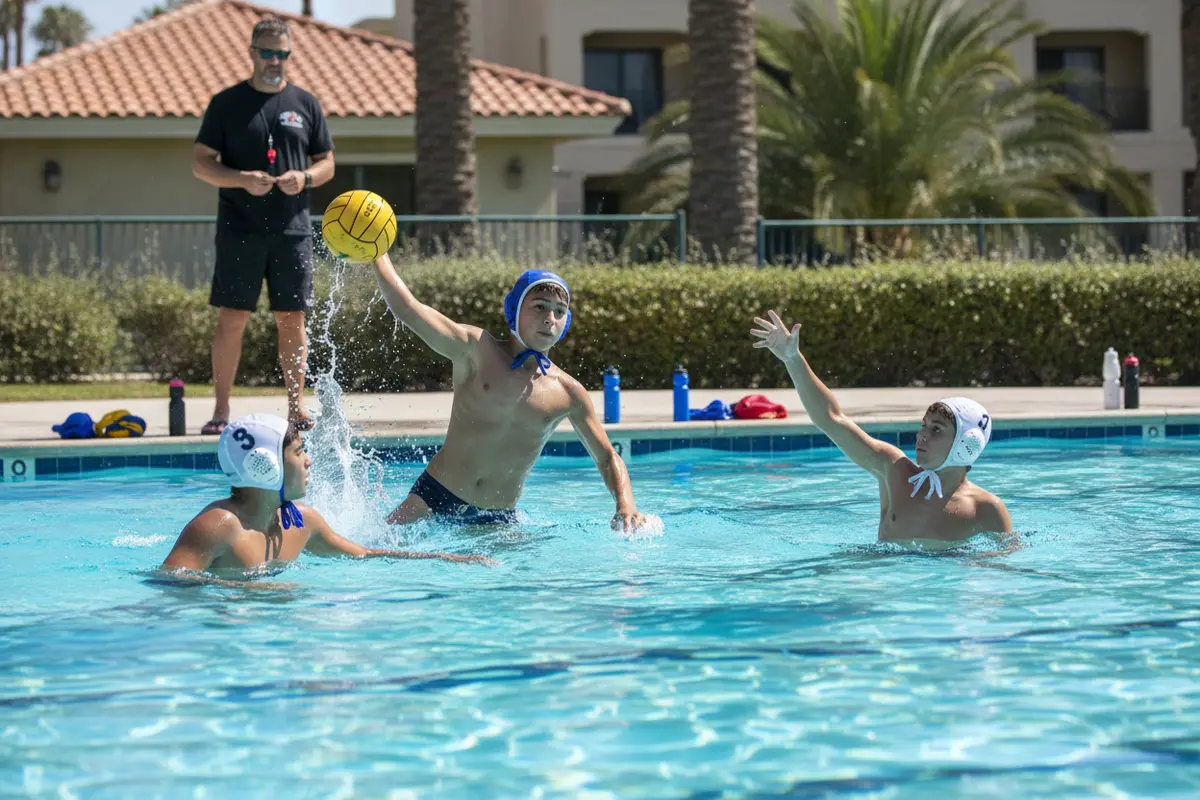
Receive, protect, and return
In pairs, one player passes while the receiver secures the ball, turns their body to shield it briefly, and returns a pass to a new target. Start without a defender. Then add a shadow defender who moves at a controlled pace and does not grab or make unsafe contact. The receiver’s task is to keep awareness up, pivot or reposition within their ability, and find the safe passing option.
Two-ball awareness
In a small area with ample space, players pass one ball around a circle while a second ball travels in the opposite direction. Begin with a large circle and slow passes. Stop if the balls or players create congestion. This drill encourages communication and awareness, but it is not appropriate for every beginner group; use one ball until players can pass and receive reliably.
Set simple success criteria: a controlled catch, eyes up before the next pass, and a choice made without rushing. If players repeatedly lose control, remove pressure or reduce the number of moving parts. Equipment such as a pull float can support separate swim-practice work, but it is not a substitute for water polo ball-handling practice or direct coaching.
What shooting drills teach placement and decision-making?
Shooting practice should teach players to choose a target and shoot under conditions they can manage. Use an appropriate goal and a qualified adult or coach to supervise. Follow facility rules, keep players clear of the shooter’s path, and retrieve balls only when play has stopped and the area is safe.
Stationary target selection
From a coach-approved distance, give each player a small number of shots. Before each attempt, call a target area or let the player choose one. Focus feedback on balance, control, and whether the choice matched the available opening—not just whether the ball went in. Younger or newer players can move closer and use a ball they can handle comfortably.
Pass, receive, and shoot
Place a passer at an angle and a shooter in a safe, open lane. The passer sends a catchable ball; the receiver secures it, looks at the goal, and takes a controlled shot. Rotate after a small number of turns. Add a passive obstacle or a defender only when players can complete the pattern without collisions and the coach can supervise the whole group.
Read the opening
Use two visible target zones. A coach or partner indicates which zone is open just before the player receives the ball. The player looks, chooses, and shoots. Keep the cue timing generous for younger players. More experienced players can respond to a moving defender or choose to pass instead of shoot. Make clear that a safe pass is a successful decision when a shot is crowded.
There is no need to promise that one exercise will produce a particular performance result. Repetition, feedback, age, experience, and the quality of instruction all matter. Record one specific observation—such as whether the player looked up before choosing—rather than comparing children by shot power.
How should you train the eggbeater kick?
The eggbeater kick supports a player’s upright position and movement in the water. Build it progressively, with rest and options to reduce effort. Players develop at different rates, so do not treat a fixed time or height as a universal standard.
- Supported rhythm: At a safe location and with supervision, players practice a comfortable alternating leg rhythm while holding the pool edge or using an approved support if available.
- Short upright intervals: Players try brief, relaxed intervals in a clear area, then rest. Cue steady breathing and a stable body position rather than demanding maximum height.
- Direction changes: When players are ready, ask them to rotate or move a short distance while maintaining control. Give one instruction at a time.
- Ball-ready position: Experienced players can hold a ball in a comfortable position during a brief interval, provided this does not compromise safe movement or breathing.
For younger swimmers and beginners, use short attempts, frequent recovery, and support that follows facility guidance. If a player is tired, uncomfortable, or unable to maintain a safe position, stop and give them a rest or a simpler task. Coaches should account for the full practice load, not just the time spent on this single drill.
Dryland strength work is a separate coaching decision. A recent study described evaluating the acute effect of a dryland maximum-strength session on water polo performance; that description alone is not a prescription, evidence of long-term benefit, or a reason to give young players maximal lifts. Review the study’s stated scope, and use qualified supervision and age-appropriate programming for any out-of-pool training.
Which defensive drills teach positioning without unsafe contact?
Defensive practice can teach players to watch the opponent, stay balanced, communicate, and move into useful space. Establish the permitted contact and boundaries for the team and competition before beginning. Keep drills controlled and stop play when players lose balance, collide, or become unsure of the rules.
Mirror movement
Pair players in a marked, open area. One leads with slow lateral or forward movement; the other mirrors while maintaining a comfortable distance. Switch leaders after a short turn. Start without a ball, then let the leader move toward a marker. The defender practices staying between the leader and the marker without grabbing, pushing, or blocking the partner’s breathing space.
Pass-lane shadow
Two attackers pass at a measured pace while a defender shadows the passing lane from a safe position. The defender aims to read the pass and move into the lane, not make contact with the receiver. Begin with predictable passes, then let attackers choose between two receivers. Award a point for good positioning or clear communication, even when there is no interception.
Recover and communicate
In groups of three, one attacker moves toward a marker, one defender tracks, and a second defender calls a simple instruction such as “left” or “switch,” using the team’s agreed vocabulary. Rotate frequently. Keep the action short so players can reset and discuss what they saw. Adapt the space to the group and avoid adding speed before players understand the route.
For team practice, use a consistent suit and cap setup that helps players identify teammates and opponents, following league and facility requirements. A racing swim cap is an example of swim equipment, but coaches should confirm any water polo-specific rules and choose gear appropriate to the session.
How can small-sided games bring the skills together?
Small-sided play gives more players chances to pass, defend, and make decisions. Use boundaries and rules that match the pool and the group. A coach should supervise actively, keep the playing area clear, and pause the game if spacing becomes unsafe.
Three-on-three to a target
Use a small, clearly marked area and a target appropriate to the facility. Teams attempt to complete a set number of controlled passes before taking a shot or sending the ball to a designated target. For beginners, remove defenders initially or allow a stationary target. For experienced players, require a change of direction or a pass to a teammate who has moved into open space.
Keep possession with a condition
One group tries to keep possession while the other group applies controlled defensive pressure. The attacking group earns a point for a completed pass after a player changes position. Limit the duration of each turn and rotate groups before fatigue affects safe movement. Do not use a winner-stays-on format if it leaves the same players working continuously.
Situation start
Start play from a specific, coach-selected situation, such as a turnover near the side or a pass to a teammate with space. Ask players to identify options before the ball moves. Use simplified rules for younger players, and make sure every participant knows the boundary and stop signal. The goal is to practice recognition and teamwork, not to simulate a high-pressure match at full speed.
Players can organize small-group swim conditioning separately with tools such as training fins or a kickboard, when these fit the coach’s plan and pool rules. Avoid using equipment in a crowded game or treating a training aid as required for water polo technique.
How do you adapt drills for age, skill, and safety?
Choose a drill version based on demonstrated readiness, not age alone. A mixed-age group may need different distances, balls, rest periods, and levels of pressure. Give players permission to stop or ask for help, and follow the pool’s supervision, emergency, and equipment policies.
| Group or readiness | How to adapt the drill | What to watch |
|---|---|---|
| New swimmers or beginners | Use one ball, short passing distances, stationary starts, simple cues, and no defender at first. | Comfort in the water, ability to follow directions, controlled receiving, and enough recovery. |
| Developing players | Add movement, a wider choice of targets, or a passive defender one change at a time. | Eyes-up awareness, safe spacing, clear communication, and technique that remains controlled. |
| Experienced players | Combine a pass with a decision, change direction, or introduce timed small-sided play with coach oversight. | Decision quality, team coordination, fatigue, and adherence to the agreed contact rules. |
| Players who are tired or uncertain | Pause, rest, reduce the area or task demands, or return to a supported version. | Breathing, balance, comfort, and whether the player can continue safely. |
This table is a coaching framework, not a medical or competition rule. Match activities to individual ability and the facility’s procedures. Provide appropriate adult supervision, account for water conditions and group size, and stop an exercise if a player is in distress or the practice area becomes unsafe.
What equipment helps organize a water polo practice?
Keep equipment simple and tied to the session goal. A suitable ball, goals or targets, and clearly visible markers may support drills, subject to facility rules. Use water polo-specific caps and suits according to the team’s needs and governing rules. Equipment details and specifications should be checked before purchase; a general swimming product should not be presented as water polo equipment unless it is actually intended for that use.
For warm-up and separate swim sets, coaches might review kickboards, pull floats, or swim goggles as general training gear. These are not required for every water polo session. Check fit, intended use, and facility guidance, especially when selecting equipment for children. A mesh swim bag can help keep personal practice items together after use.
Frequently asked questions about water polo training drills
How many drills should a water polo practice include?
There is no single number that suits every team. Choose a small set that fits the practice time and goal, and allow enough repetitions for players to learn each activity. A session with a clear progression is often easier to coach than one that rushes through many unrelated drills.
What are useful water polo drills for beginners?
Start with partner passing, a simple triangle pass, supported ball control, and short movement tasks in a supervised area. Keep distances short and remove defenders until players can move and handle the ball with confidence. Follow pool rules and use qualified supervision for swimmers of every level.
How can coaches make eggbeater drills easier?
Reduce the duration, add recovery, and let players practice a comfortable rhythm in a supported or less demanding position permitted by the facility. Avoid comparing players by height or time in the water. Progress only when the player can maintain control and breathe comfortably.
Can dryland strength work replace pool drills?
No. Dryland activity and pool practice have different purposes, and neither automatically replaces the other. Any strength plan should reflect the athlete’s age and experience and be supervised by a qualified coach; research on an acute session does not by itself establish a long-term training prescription.
What should a coach do if a player becomes tired during a drill?
Stop or simplify the activity, let the player rest, and follow the facility’s safety and emergency procedures. Do not pressure a swimmer to continue when uncomfortable or unable to maintain a safe position. Keep other players supervised while addressing the situation.
Browse swim practice gear for your team
Ready to build your next practice?
Choose one skill to emphasize, set a safe progression, and finish with a short game that lets players apply what they practiced. Adjust the session to the swimmers in front of you, and use clear feedback to help the whole team improve together.


