


A swim timing system can mean anything from a coach’s stopwatch and pace clock to electronic lane equipment used to record race results. The right setup depends on what you need to measure: practice intervals, individual lap splits, or official meet times. This guide explains the parts, use cases, and questions teams can compare before they invest.
Explore a simple way to track laps
What does a swim timing system include?
A swim timing system is a set of tools for measuring and recording time in the water. The phrase may describe a modest practice setup or a complete meet arrangement. It does not always mean a single machine, and one product will not necessarily perform every timing job.
For daily training, the basic setup may be a visible pace clock, a coach’s stopwatch, and a written or digital record of intervals. A pace clock helps swimmers see when to leave for a repeat; a stopwatch lets a coach time an individual swimmer or a group. A lap counter, meanwhile, helps keep track of how many lengths someone has completed. It does not automatically produce official race times.
At a competition, a more extensive arrangement may include lane-specific starting equipment, touchpads at the wall, a central timing console, result software, and a manual backup. The exact equipment and procedures depend on the event, facility, meet rules, and the organization running the competition. Some systems use electronic signals and connections between components; others rely more heavily on officials and handheld watches.
The distinction matters: timing a set for practice is not the same task as producing race results that a meet can accept. Before comparing equipment, write down the result you need—interval feedback, lap counts, recorded splits, or competition results.
In short: a practice clock or stopwatch can support training, while a meet-ready system coordinates timing across lanes and may connect to result recording. A lap counter tracks lengths; it is not a substitute for a race timing system.
Which parts matter for practice and for meets?
Start by identifying the people who will use the equipment and the environment where it will operate. A small training group may need a clear pace reference and a reliable way for a coach to time repeats. A team hosting a meet needs a plan for multiple lanes, official procedures, result handling, and backup timing.
Practice tools
- Pace clock: Gives swimmers a shared visual reference for send-offs and repeat intervals. Check that it can be seen from the starting end and, if needed, from both ends of the pool.
- Handheld stopwatch: Lets a coach measure an individual or lane. Consider the number of coaches and lanes, how times will be recorded, and whether buttons are easy to use during a busy session.
- Lap counter: Helps a swimmer or observer keep track of lengths during longer sets. It supports counting rather than automatic race timing. Swim2000 lists a Water Gear Lap Counter among its swim accessories.
- Training aids and notes: Equipment such as a pull-kick training aid or pull buoy may be part of a set, but neither measures time. Keep timing records tied to the swimmer, distance, and interval so the result has context.
Meet equipment
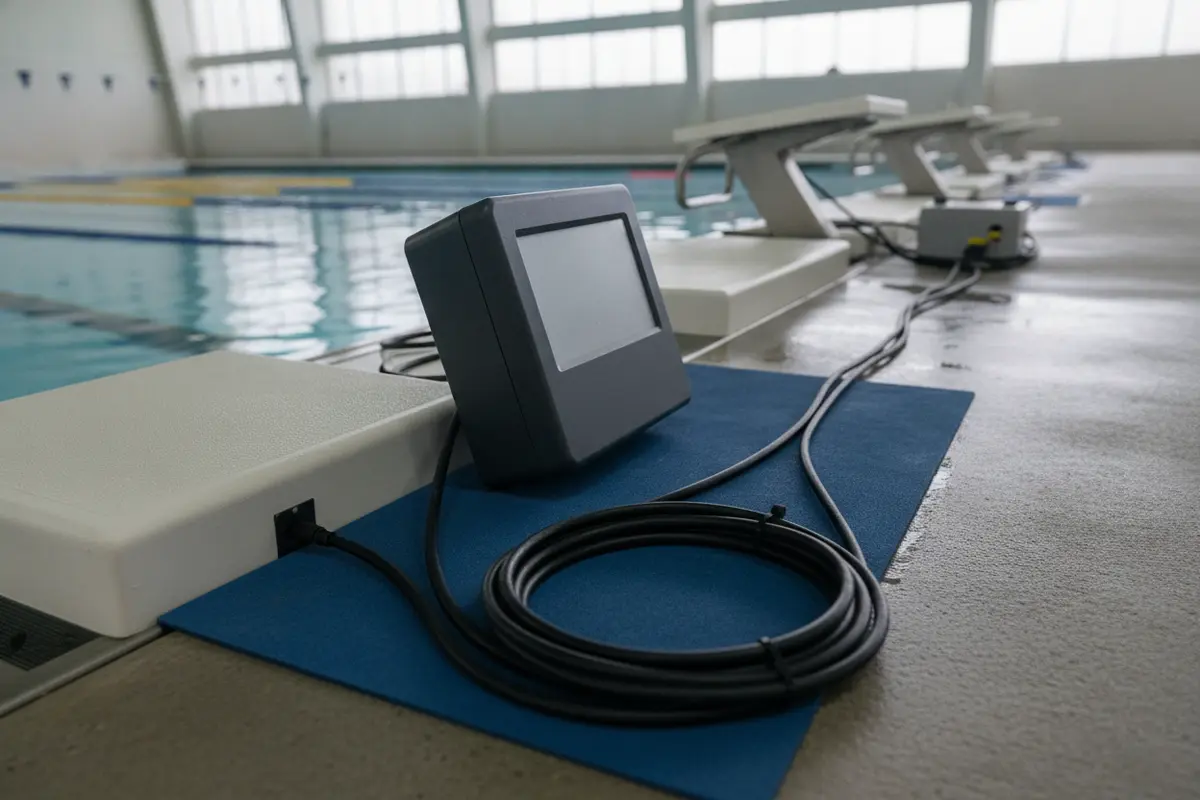
Meet timing often requires more coordination than practice. Depending on the meet, equipment can include a start signal, lane touchpads, timing cables, a console, software for managing events and results, and manual watches as a backup. A facility may already have some of these components. Verify what is installed, working, and compatible before purchasing anything.
Touchpads are positioned so swimmers finish against them, and the system records a finish signal. A central console receives lane information and supports event timing. The people running the meet still need clear roles: who starts the event, monitors equipment, checks exceptions, records backups, and confirms results. Electronics can reduce manual recording work, but they do not remove the need for a tested procedure.
Competition rules can set expectations for acceptable timing methods and backup procedures. For example, the Colorado Timing System document describes timing systems in the context of swimming competition and lists preferred methods of timing. Check the applicable governing-body and meet rules rather than assuming a system is approved for every event (Colorado Timing System timing guidance).
Practical takeaway: practice equipment should make a coach’s or swimmer’s immediate task easier. Meet equipment must also work as part of a coordinated lane, results, and backup process. Identify the setting first, then decide which components are actually needed.
How do manual, semi-automatic, and electronic systems compare?
Labels such as manual, semi-automatic, and automatic are useful starting points, but they do not explain every setup. Ask what starts the clock, what records a finish, how lane times reach the results operator, and which backup is available if a component fails.
| Approach | Typical use | What to check | Main trade-off |
|---|---|---|---|
| Manual stopwatch timing | Practice sets, small sessions, or a backup method | Number of timers, recording method, reaction consistency, and backup procedure | Simple to deploy, but staff must time and record each result |
| Visible pace clock | Send-offs and interval work during practice | Readability from the pool, mounting or placement, and power needs | Useful shared reference, but does not record an individual’s official finish time |
| Touchpad and console setup | Meets that use electronic lane timing | Pool compatibility, lane count, cabling, operation, result workflow, and backup | Can coordinate lane finish signals, but requires compatible equipment and trained operators |
| Wireless or integrated timing setup | Facilities or teams seeking connected timing components | What is transmitted, synchronization, signal reliability, power, and meet acceptance | May reduce some cable handling, but system capabilities and rules vary by product and event |
These are broad categories, not promises about a particular product. A wireless system may still need sensors or other lane equipment, while a touchpad installation may need pool-specific connections. Confirm the complete configuration with the manufacturer and the meet organizer.
For context, the Georgia Parks Aquatic Swim Association’s information page says its teams use the Time Drops wireless swim timing system for electronic timing at meets. That is an example of a local association’s reported use, not proof that one system is right for every facility or meet (GPSA information about its timing system).
When comparing approaches, consider what happens after a time is captured. A practice note might be a line in a coach’s log. A meet result may need to be associated with the correct event, heat, lane, and swimmer, then checked and passed into a results workflow. The equipment choice is only one part of that chain.
How can a team choose the right setup?
First define the job. A team that needs interval visibility may not need meet hardware. A facility hosting competitions should map the timing system to its pool, event workflow, staffing, and competition requirements. These steps make product conversations more specific.
- List the use cases. Separate daily practice, time trials, and sanctioned or hosted meets. Note whether you need intervals, individual splits, finish times, or published results. Include less frequent uses, such as a team time trial, so that occasional needs do not quietly dictate an oversized daily setup.
- Count lanes and users. Record the number of lanes, training groups, and people who will operate the equipment. Consider whether the system will be shared between pools or stored between events. If several groups train at once, note whether they need separate timing references or can share one clock.
- Document the facility. Check pool length, starting and finish locations, existing wiring or timing infrastructure, available power, display visibility, and any restrictions on mounting or cables. Note whether equipment must be carried in and out, and where it can be stored safely between sessions.
- Check compatibility and rules. Ask whether the proposed hardware works with the facility’s existing equipment and results software. Confirm the timing method accepted by the governing body and meet director for the events in question.
- Plan the people and process. Identify who starts races, watches lane signals, records manual backups, resolves missed or questionable signals, and reviews results. A written operating plan helps volunteers prepare.
- Test before relying on it. Run practice trials in every lane. Test start, finish, display, data transfer, and backup steps. Record problems and resolve them before meet day.
Turn the answers into a short written specification. For example: “We time six lanes for weekly practice, need a visible send-off reference, and host two meets that require recorded lane finishes.” That is more useful than asking for “the best timing system,” because it gives a supplier or facility manager practical constraints to evaluate.
A coach timing one practice lane can use a very different process from a volunteer crew responsible for a multi-lane meet. Be clear about that difference when you ask a supplier or facility manager for recommendations. If a system will serve more than one pool, make a separate checklist for each site instead of assuming that identical lane counts mean identical installation needs.
Decision summary: match the simplest setup to the task you need to perform, then add complexity only when a defined workflow or meet rule calls for it. A written use-case list also helps prevent buying components that do not connect to the current facility.
What should you ask about cost, setup, and maintenance?
There is no reliable single price for a swim timing system based on the name alone. A basic practice arrangement and an electronic meet installation can contain very different equipment. Costs may depend on the number of lanes, displays, touchpads, cables, software, installation, training, and ongoing support. Ask for a complete list of what the quote includes and what must be purchased separately.
- Included components: Does the proposal include starting equipment, lane sensors or touchpads, console, displays, software, cables, connectors, and storage?
- Installation and compatibility: Is setup included? Will the system connect to the pool’s existing hardware and results process? Who confirms compatibility?
- Training and support: What instruction is provided for coaches, operators, and volunteers? Who can help troubleshoot before or during an event?
- Consumables and repairs: Which parts may need replacement? Ask about service, repair turnaround, and availability of compatible replacement components.
- Power and transport: Find out whether the system needs mains power, batteries, charging, special storage, or careful transport between facilities.
- Upgrade path: If needs grow, can you add lanes or connect additional displays without replacing the entire setup?
- Software and data: Are there recurring fees, account requirements, file formats, or export steps? Confirm who retains access to results and what happens if a computer or network is unavailable.
For a practice-only purchase, compare the visibility and ease of use of clocks and stopwatches with how your team currently records times. For meet equipment, ask for a written compatibility check and a demonstration using the same pool and workflow where possible. Do not treat a low upfront price as the whole cost if installation, software, training, or backups are separate.
It also helps to estimate the time required to operate and maintain the setup. A volunteer-run meet may need a clear quick-start sheet, labeled cables, a charging routine, and a designated person to inspect the kit before events. A coach-led practice may prioritize a tool that can be set up quickly without interrupting the session. Ask the seller or facility staff what regular checks are recommended; do not assume that every system has the same care instructions.
How can swimmers and coaches improve timing consistency?
Good timing depends on both equipment and technique. For practice, agree on the start and finish points before a set. Use the same lane landmarks and timing method when comparing repeats. Record the distance, stroke or drill, interval, and conditions along with the time. A number without context may be hard to interpret later.
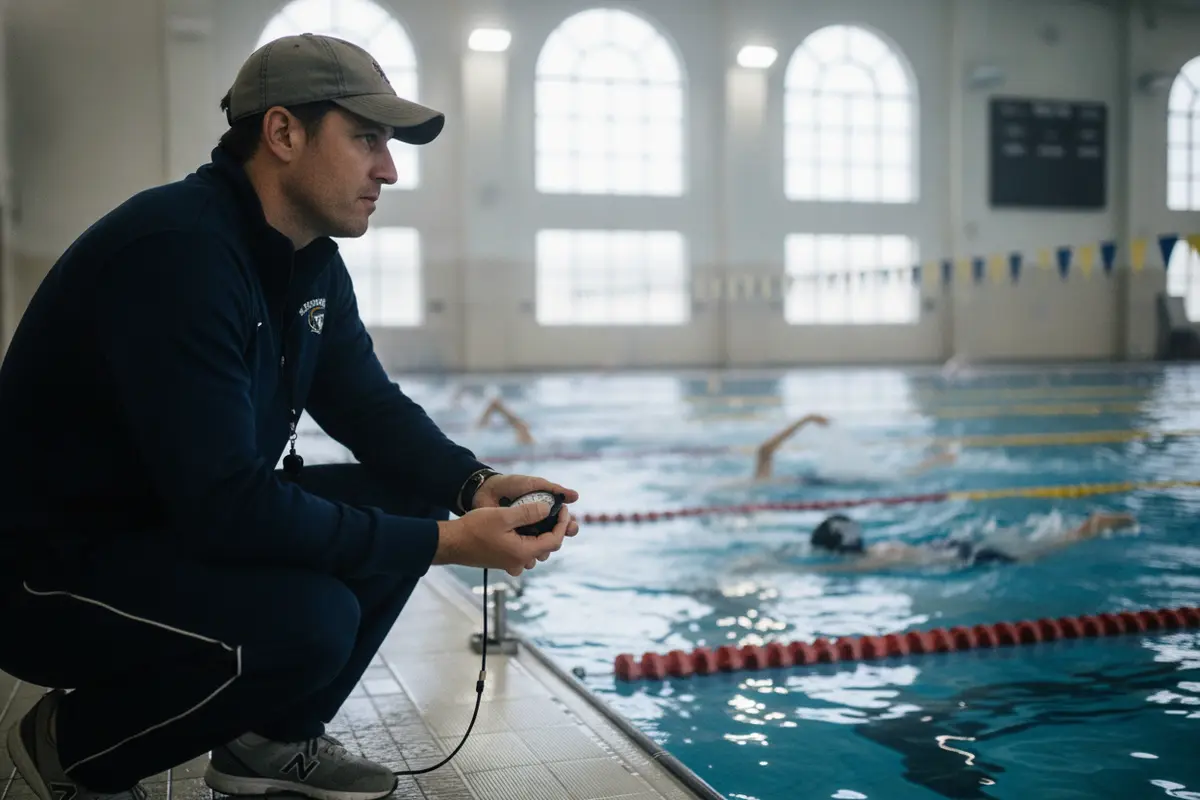
For manual timing, have the timer focus on the swimmer’s finish and use a consistent start cue. If multiple people time the same swim, compare results to understand variation in the process rather than assuming every difference reflects the swimmer. Keep handheld watches in good working order and train more than one person to use them.
For an electronic setup, check each lane’s connection and display before the session or meet. Make sure operators know how to identify a missed signal and follow the backup procedure. A manual record can be useful when equipment is unavailable or a signal needs review, but the meet’s rules determine how such a result is handled.
During practice, establish a routine that everyone understands. Before the first repeat, state whether the clock starts when the swimmer leaves the wall, on a sound, or at another agreed cue. Explain whether the displayed time is a split, a total elapsed time, or simply the send-off interval. Swimmers rotating through a lane should know which watch or clock is being used and who is responsible for recording the result.
For a set with several swimmers, a simple recording sheet can use columns for swimmer, distance, repetition, start cue, time, and notes. A note such as “push start, 100-yard repeat, lane 3” makes future comparisons clearer than a bare number. If the coach changes the timing method mid-set, mark that change instead of treating times collected by different methods as directly interchangeable.
Equipment can support feedback, but a time alone does not explain why a swimmer’s result changed. Consider the distance, training purpose, conditions, and technique when discussing a set. A goggle anti-fog product or a comfortable pair of training goggles may help swimmers stay focused on the session, but neither replaces correct timing procedures. Teams may also keep a swim cap or pool towel in their routine kit; those are accessories, not timing components. A pair of training fins or swim snorkel may be used in particular drills, but record the equipment and drill context if you compare times across sessions.
What troubleshooting steps help on practice and meet day?
A short troubleshooting plan reduces last-minute uncertainty. Assign one person to check the setup before a session and make sure operators know who to contact if a component stops responding. For a practice clock, check visibility, power, and the selected display mode. For a meet installation, include a lane-by-lane test and a clear method for recording a backup time if a signal is missed.
- Check the basic connection. Confirm power or battery status, plugs, cables, and any wireless pairing required by the manufacturer. Look for a loose connection before assuming a sensor or console has failed.
- Confirm the display and settings. Verify that the clock or console is showing the intended event, mode, and lane information. Make sure operators can read it from their working position.
- Run a real start-to-finish test. Use a swimmer or a safe test process to confirm the start cue, lane signal, console response, and result entry. A powered-on console alone does not prove that the complete chain works.
- Use the documented fallback. If timing data does not appear, follow the meet or practice plan rather than improvising a result. Record what happened and notify the person responsible for checking the time.
- Reset and review. Clear test data as instructed, verify the next event or set is ready, and review unusual results before they are shared.
Keep the manufacturer’s instructions with the equipment and label components if several kits are stored together. At the end of an event, inspect cables and pads, dry and store items as instructed, recharge batteries when needed, and note any intermittent faults. Reporting a problem while it is fresh is more useful than finding an unexplained failure at the next meet.
What common mistakes should teams avoid?
- Buying for a vague need: “We need better timing” is not a specification. Decide whether the goal is practice intervals, lap counts, recorded splits, or meet results.
- Confusing a lap counter with a timing system: Counting lengths and measuring elapsed time are separate tasks. A counter may help a swimmer track a long swim but does not record a lane finish.
- Assuming equipment is compatible: Similar-looking connectors or displays do not guarantee that components work together. Confirm exact models and configurations with the facility or manufacturer.
- Ignoring backup procedures: Batteries run down, signals can be missed, and cables can be disconnected. Decide what operators do when the primary system does not capture a time.
- Skipping a full test: Testing only the console or one lane can leave problems undiscovered. Test the complete start-to-result process in every lane.
- Using practice timing as proof of meet acceptance: Confirm the applicable rules and meet procedures before relying on a method for competition results.
- Choosing features without an operator: A complex configuration is of little help if no one is trained to set it up, watch for errors, and transfer results. Include staffing and training in the decision.
- Failing to label what a time means: A split, total time, and send-off interval answer different questions. Record the measurement type so a result is not misunderstood later.
Make the timing procedure easy to follow. A short checklist, clearly assigned roles, and a test session can prevent confusion when swimmers are ready to start. Teams can also place the quick-start instructions and backup plan with the equipment so a substitute coach or volunteer can find them quickly.
Browse swim training gear for your team
Frequently asked questions about swim timing systems
Is a swim timing system the same as a swim watch?
No. A watch is a personal device for measuring elapsed time or other activity data, depending on its features. A team or meet timing system coordinates timing for swimmers and lanes, and may transfer results to a central console or software. Choose based on whether you need personal feedback, practice timing, or competition results.
Can a lap counter record a swimmer’s time?
A lap counter is intended to help track lengths, not to replace a stopwatch or electronic timing system. If you need both distance and time, decide how each will be measured and recorded. A coach or swimmer can pair a counter with a separate timing method for practice.
Do all swim meets use touchpads?
No. Meet equipment and accepted timing procedures vary. Some events use electronic lane timing, while other arrangements may rely on manual or other approved methods. Check the meet information and governing rules before assuming a particular setup is required or accepted.
What should a small team buy first?
Start with the specific training need. If swimmers need a shared reference for intervals, look at a visible pace clock. If a coach needs to record individual repeats, a stopwatch and consistent recording process may be the more relevant starting point. A lap counter is useful when the challenge is remembering lengths, not measuring race times.
Before choosing equipment, match its job to your team’s practice or meet requirements, verify facility compatibility, and test the complete timing process with the people who will use it.


