

If you are new to competitive swimming, you may be asking: what is a swim meet, and what happens when you arrive? A swim meet is an organized competition where swimmers race in scheduled events, usually grouped by stroke, distance, age, and sometimes qualifying standard. Knowing the basic routine helps swimmers and families arrive with a plan instead of trying to figure everything out on the pool deck.
Explore swim gear for practice and meet day
What happens at a swim meet?
A host team or organization arranges the pool, schedule, timing system, and officials. Swimmers attend with their teams, complete a warm-up, and race in the events for which they were entered. Coaches help swimmers prepare and report at the right time. Families usually watch from designated spectator areas, which may be separate from the pool deck.
The meet is divided into events. An event names a race, such as the 100-yard freestyle or 50-meter backstroke. Each event may have multiple heats because the pool has a limited number of lanes. A heat is one group racing the same event at the same time. A swimmer is assigned a heat and lane; those details may appear in a printed program, a posted sheet, an electronic board, or a meet app.
Meets may use timed finals or preliminary and final sessions. In a timed-finals format, each swimmer races once, and times from all heats are compared to determine the event standings. At a preliminaries-and-finals meet, swimmers race in an earlier session and eligible qualifiers return for a later final. The meet announcement and coach explain the format. Winning a heat does not automatically mean winning the full event, since swimmers in other heats may record faster times.
For example, imagine an event with four heats. One swimmer may win heat two, but the final result is based on the times across all four heats, unless that meet has a separate finals procedure. Families can avoid confusion by checking event results rather than judging solely by who touched first in one heat.
Key takeaway: a swim meet is a sequence of scheduled races, not one continuous race. Know the session format, then use the host’s instructions and the coach’s guidance to follow the day.
How are events, heats, and results organized?
Events are commonly listed in numerical order. Within an event, swimmers may be grouped by age or eligibility and then divided into heats. A heat sheet or electronic display may show the event number, heat, lane, swimmer, and entry time. The entry time helps organizers seed swimmers into heats; it is not a guaranteed finish time or a promise about where someone will place.
| Meet term | What it means | What to check |
|---|---|---|
| Event | A race category defined by stroke and distance | Which event numbers the swimmer is entered in |
| Heat | One group swimming the same event at the same time | Heat number and when to report |
| Lane | The swimmer’s assigned place in the pool | Lane assignment and any posted update |
| Entry time | A submitted time used for organizing or seeding | Whether it is accurate and listed in yards or meters |
| Final | A later race for eligible qualifiers at some meets | Whether the swimmer must return for another session |
| Relay | A team race in which swimmers complete separate portions | Order, takeoff directions, and team check-in |
Course length matters. A meet can be held in a yards or meters pool, and the course is specified in the meet materials. A 100-yard race and a 100-meter race cover different distances. If a time looks unfamiliar compared with practice, check the course before comparing it with another swim. Relay events add team coordination: swimmers complete separate portions in an assigned order, with the coach explaining where to wait and when to report.
Officials supervise starts, turns, finishes, and compliance with applicable rules. A disqualification can occur when an official determines that a rule was not followed. It is useful to let the coach explain the call and what the swimmer can learn from it; a first meet is not the time for a family member to guess at a rule from the stands. For USA Swimming resources and rules, consult USA Swimming’s official site. The applicable rules depend on the governing organization, so this resource does not replace the host’s instructions for another league or meet.
In brief: event, heat, lane, course, and format are separate details. Check each one, and ask the coach if a schedule or assignment is unclear.

What should a first-time swimmer expect?
A first meet is as much about learning the routine as racing. Arrive at the time the coach gives you, find the team area, and take part in the team warm-up. Swimmers then check their assignments, stay close enough to hear team instructions, and report to the staging area before their races. Pool procedures vary: one venue may call swimmers by event and heat, while another may have a clerk of course or a designated waiting area. Follow the local directions rather than assuming every meet works the same way.
There can be long gaps between races, followed by a quick move when an event is approaching. Keep belongings together and bring quiet activities only if the team and venue allow them. Drink water regularly, and bring familiar food the swimmer already tolerates rather than testing unfamiliar snacks on competition day. Swimmers should ask a coach before leaving the team area so that they do not miss an instruction or call.
Before leaving the team area to report, confirm four items: event, heat, lane, and reporting location. If the schedule changes, follow the latest team or host update rather than relying only on a printed sheet. If an announcement is missed, ask the coach or meet staff promptly. A swimmer can carry a small written list of events if that is allowed, but the list should support—not replace—listening for updates.
Make the heat sheet useful by reading it before the session gets busy. Locate the swimmer’s event numbers and notice how their listed name, heat, and lane are shown. If the host posts updates electronically, check whether families may use a phone in the viewing area and whether the team has a preferred update channel. Do not assume the order is moving at the same pace as the original estimate. The coach can tell swimmers when to begin getting ready, while parents can help keep track of the schedule without calling a swimmer away from team instructions.
Families can lower pressure by focusing on effort, learning, and enjoyment. A race is one moment, not a complete measure of progress. Afterward, ask how the swim felt or what the swimmer noticed before discussing the time. Leave technical corrections to the coach, who can place the result in the context of practice and the swimmer’s goals.
Takeaway: the first competition is a chance to learn how the pool, team, and schedule operate. A steady routine and clear communication matter more than knowing every detail in advance.
How can you prepare for the meet before race day?
Start with the meet information and the coach’s message. Confirm the date, pool address, arrival time, warm-up plan, session format, spectator rules, and whether swimmers need to check in or bring a particular item. Write the answers in one place. If the meet has multiple sessions, confirm which one applies to your swimmer; a long event schedule does not necessarily mean every swimmer attends every session.
Then review the entries. Note each event number, stroke, distance, and whether the swimmer is entered in a relay. Ask the coach to clarify anything that seems unfamiliar, including course length and how heats will be called. Do not assume that a printed order tells you exactly when to arrive at the blocks: event progress can change, and the staging process may start before the race itself.
A simple preparation timeline helps. Two or three days ahead, check the team’s requirements and make sure familiar equipment is ready. The evening before, pack the bag and put the schedule where it can be found. On meet morning, allow time for travel, finding the team area, and following check-in directions. Once on site, locate restrooms, spectator seating, the team gathering place, and the route to the reporting area. These small steps reduce last-minute questions.
Test new equipment during practice rather than introducing it at the meet. If a new pair of goggles feels uncomfortable or slips during a push-off, there is time to adjust or choose a familiar pair. Similarly, use new swimwear in practice first when possible, following care instructions and the coach’s advice. Changing several items at once makes it harder to know what feels comfortable.
Summary: gather the host’s details, record the swimmer’s entries, prepare familiar equipment, and follow the team’s arrival and warm-up plan. A checklist turns vague anticipation into a few manageable actions.
What belongs in a practical swim meet bag?
Pack the evening before, then check the team’s list. Begin with what the swimmer already uses in practice: a suitable swimsuit, familiar goggles, and a cap if required or preferred. A tested spare pair of goggles can help if a strap breaks or a seal becomes uncomfortable. Pack towels and warm, comfortable clothes for time between races. A mesh bag separates wet equipment from dry belongings after swimming.
- Swimwear that is comfortable and permitted for the meet.
- Familiar goggles and, if available, a tested backup pair.
- A team or meet-required cap, plus a spare if practical.
- Towels and warm layers for the time between events.
- A water bottle and familiar snacks, subject to venue rules.
- A mesh bag for damp gear and a separate bag for dry clothes.
- Any personal items the swimmer needs, clearly labeled.
- The schedule, team instructions, and a way to check updates.
- Optional quiet activity for long waits, if allowed by the team and venue.
Use a short check rather than packing every item in the house. Ask: will the swimmer wear or use this today, is it required, and is it allowed in the venue? Training equipment is usually unnecessary for racing unless a coach specifically requests it for warm-up or practice. Keep wet and dry items separate so that the swimmer can change comfortably and the rest of the bag stays organized.
A mesh equipment bag can hold damp gear after a swim, and a quick-drying swim towel is one towel option to consider for a day with several races. These are examples, not required meet items. Check the team’s list and the venue’s rules before adding food, equipment, or large bags.
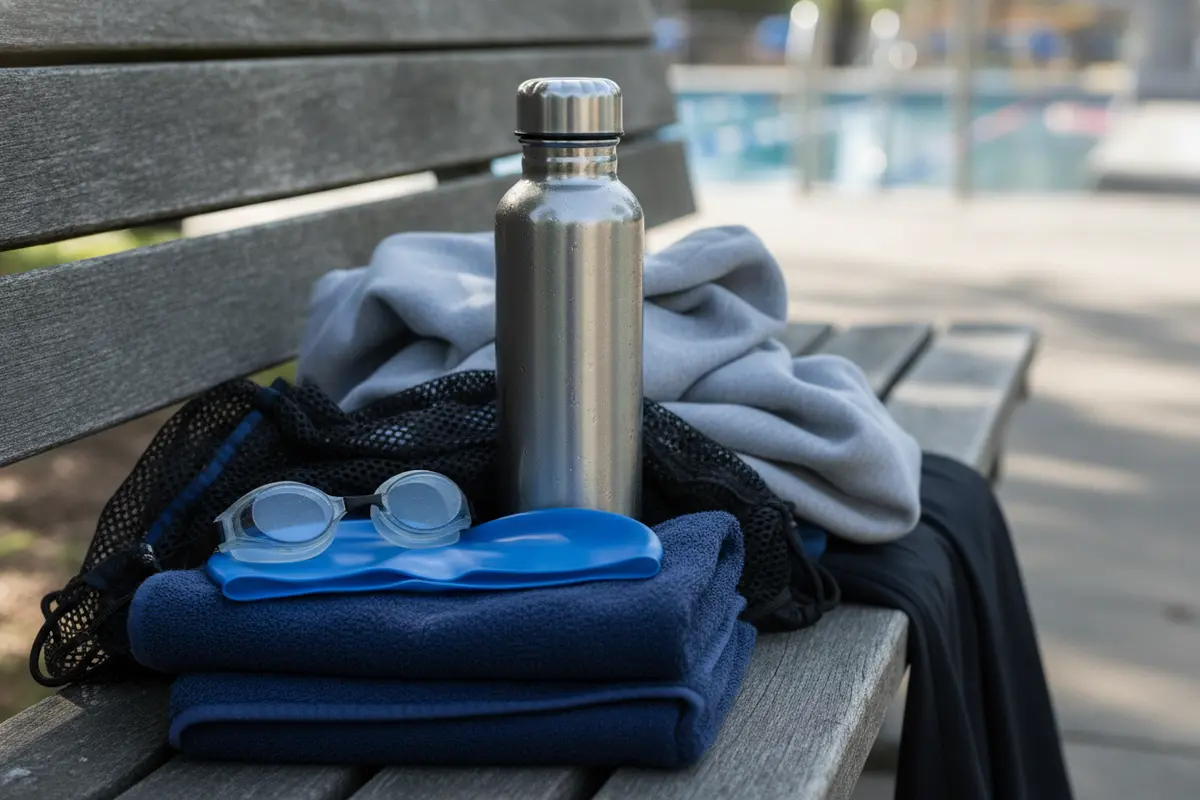
Pack simply: prioritize familiar basics, sensible backups, and the instructions that apply to this particular meet. An organized bag is easier to use during a short break between races.
Which gear matters most on meet day?
Prioritize fit, comfort, and reliability over the number of products in the bag. Goggles should seal without excessive pressure and stay in place during push-offs. The swimmer should know how to adjust them confidently. If you are considering a new model, check the manufacturer’s instructions and evaluate fit before race day. For example, Arena Cobra Ultra Swipe goggles are one product to assess for an individual swimmer’s fit; no single model fits everyone.
Choose swimwear according to the event, team advice, comfort, and meet rules. Brand sizing can differ, so use the specific manufacturer’s chart rather than assuming a size transfers from one label to another. Follow the product’s care and handling instructions; delicate technical fabric can be stressed by rough pulling or handling. Everyday training swimwear may be suitable for a first meet, depending on the event rules and coach guidance. No suit can promise a particular result.
For a technical racing suit, confirm the swimmer’s eligibility before buying or packing it. Requirements can vary by age, governing body, and meet. Ask the coach or organizer if the rules are unclear, and do not assume that a product listing alone confirms it is permitted in a particular race. A good practical choice is the one that is allowed, fits as intended, and can be put on and cared for according to its instructions.
Training aids belong in the bag only when requested. A pull-kick training aid or pull buoy may be used in practice under a coach’s direction, but is not automatically needed for a race. Likewise, hand paddles are training equipment, not a default meet requirement. Keep the kit focused on what the swimmer will actually use that day.
Gear check: make sure each item has a clear purpose, fits the swimmer, and meets the event’s requirements. Confirm uncertain equipment with the coach before race day.
What should parents and spectators know?
Read the host’s information before setting out. It may cover spectator entry, seating, parking, food, photography, and arrival times. Some pools have limited space or keep families in specified areas. Bring a layer because indoor facilities can feel cool or humid, and allow enough time to find the correct entrance and team area. If the host limits photography, respect the policy and other families’ privacy.
Keep the schedule handy, but understand that sessions can run ahead or behind. Follow team instructions if the event order changes. Spectators should stay out of restricted deck areas and avoid distracting swimmers who are preparing to race. If you need to leave the seating area, tell the swimmer where you will be, rather than asking them to look for you while they should be listening to the coach.
Encouragement is most useful when it supports the swimmer without adding pressure. Celebrate showing up, following directions, trying a new event, or cheering for teammates. If a race did not go as hoped, listen first and leave detailed analysis to the coach. For younger swimmers, a simple message such as “I liked watching you give it a try” can keep the focus on participation rather than a result they cannot control.
Families buying equipment can compare purpose and fit instead of choosing an item because another swimmer owns it. A product that works well for one athlete may not suit another swimmer’s fit or routine. Check team requirements, sizing guidance, and the meet’s rules before spending on equipment that may not be used.
How can you make the first meet less stressful?
Reduce uncertainty with a short plan. Ask the coach when to arrive, where the team will gather, what warm-up equipment is needed, and how swimmers will be called. Write down event numbers, prepare the bag, and identify where results or schedule updates appear. If practical, watch an earlier race to see how swimmers are staged and how the pool area is arranged.
Use a simple sequence: arrive and find the team, warm up, check assignments, report before each race, swim, then recover and review the next event. It is a reminder, not a substitute for coach instructions. A swimmer with multiple events can use the pause between races to dry off, add a layer, drink, and check the next reporting time. They should stay close enough to hear directions and avoid wandering away just as an event approaches.
Nerves are normal when the pool and routine are unfamiliar. Explain that the goal of a first competition is to learn the setting and complete the races, not to master every detail at once. If a rule, time, or disqualification is confusing, write down the question and ask the coach when there is time to discuss it calmly. This gives the swimmer an answer without interrupting warm-up or race preparation.
Keep race-day choices familiar. If an athlete has used particular goggles and swimwear comfortably in practice, avoid switching multiple items just before the meet. A coach may recommend equipment for training, such as training hand paddles, but that does not make it race-day equipment. The simplest plan is often to bring the basics, listen carefully, and take each event in order.
For a calmer day: prepare the practical details, let the coach lead the swimming instructions, and give the swimmer room to experience the meet at their own pace.
Explore a swim cap option for meet day
Frequently asked questions about swim meets
How long does a swim meet last?
It depends on the number of events, entries, and sessions. A session may take several hours, and swimmers with multiple races may be at the venue for much of the day. Check the host schedule and ask the coach about arrival and departure expectations for your swimmer.
Does winning a heat mean winning the event?
Not necessarily. At a timed-finals meet, times are generally compared across heats to determine the event results. The fastest swimmer in one heat may not have the fastest time overall. A meet with preliminaries and finals uses its own advancement and final-result procedure.
What should a beginner wear to a swim meet?
Wear comfortable swimwear that meets event requirements, along with familiar goggles and a cap if required. Check the coach’s advice and any special rules before buying a technical suit. Use the brand’s sizing and care instructions for the specific item.
Do swimmers need special equipment at a meet?
Most beginners need basic swimwear, goggles, and any required cap. A tested spare pair of goggles, towels, warm layers, water, and a bag for wet gear can make the day easier. Ask the coach whether team-specific items are needed; training aids are not automatically required for racing.
How do I know when my swimmer’s race is coming up?
Use the meet program, posted heat sheet, or approved event updates, and listen for team instructions. Confirm the event, heat, lane, and reporting location with the coach if anything is unclear. Follow the latest update if the schedule changes.
A first swim meet becomes easier when you understand the schedule, prepare familiar gear, and follow the coach’s directions. Focus on learning the routine and supporting the swimmer; experience builds from one race to the next.